
Carbon Dome
An airborne shield against mass drone attack.
Carbon Dome is a fully integrated, next-generation autonomous counter‑UAS (C‑UAS) architecture that detects, tracks, and destroys hostile drones with its onboard, layered arsenal of interceptors.
- Patrol altitude
- 20,000 ft
- Time on station
- Up to 15 hours
- Takeoff and landing
- No runway
Design targets for the full-size Daedalus aircraft, shown here. Requirements are tradable at the same maximum takeoff weight — less fuel buys more interceptors, and the reverse.
Carbon Dome, in seventy-five seconds
An airborne shield against mass drone attack, from the mothership on station to the last intercept.
Cheap drones broke the economics of air defense.
One-way attack drones are built by the thousand and cost a fraction of the missiles sent to stop them. They arrive in large numbers, often at night, and newer types fly higher and faster than the guns and shoulder-fired missiles that used to reach them.
A ground-launched interceptor starts from zero. It has to climb to the threat, and every second of climb is a second the drone gets closer.
Carbon Dome starts from above. A mothership already on station releases an interceptor that dives onto the target and trades height for speed.
The cost exchange
The drone is cheap. The answer usually isn’t.
A Shahed-type drone costs tens of thousands of dollars. The missiles most often fired at it cost up to a hundred times more. Set the size of the raid and see who wins the exchange.
948 is the record: Shahed-type drones launched at Ukraine in 24 hours on 23–24 March 2026.
Public estimates range from about $20,000 to $50,000.
Some engagements need a second shot.
The attacker spends
$33.2M
Answering every drone with a Patriot missile would cost 120 times what the attacker spent.
-
Patriot PAC-3 MSEabout $4.2M per shot
-
NASAMS (AIM-120)about $1.1M per shot
-
Coyoteabout $126K per shot
-
Carbon Dome$5K–$15K per intercept, planning estimate
What the attacker spent. Bars to the right of the line cost the defender more than the attack. Log scale.
Cheap shots already exist, but they can’t keep up with Russia’s newest jet‑powered kamikaze drones.
Ukraine already fields interceptor drones in the same price range as Carbon Dome’s planning estimate, so we don’t claim the cheapest shot. But most were built to catch the propeller-driven Geran‑2, and they struggle against the jet-powered Geran‑3, ‑4, and ‑5, which fly at 300 to 500 km/h.
Carbon Dome carries different types of interceptors and assigns the right one to each threat. It starts high and ahead of the attack: on station at about 20,000 ft, forward of the defended area, and designed to stay there for up to 15 hours. Its interceptors meet a fast drone instead of chasing it.
Illustrative. Real air defense is layered: no defender fires a Patriot at every drone, and every system, ours included, carries costs beyond the shot itself. Per-shot prices are public estimates and change with budget year and contract. The Carbon Dome figure is a rough-order-of-magnitude planning estimate for a system in development, not a price or an offer.
Sources
- Raid size: Ukrainian Air Force, reported by Al Jazeera and ACLED.
- Drone cost, $35,000 planning value: CSIS.
- PAC-3 MSE, about $4.2M in the FY2025 Army budget: Drone Warfare. The FY2027 request is about $5.3M: The War Zone.
- AIM-120, about $1.1M per round in Air Force budget data: The War Zone.
- Coyote, about $126,500 per interceptor (CNAS), reported by Der Standard / The New York Times.
- Jet-powered Geran speeds and the limits of current interceptor drones: Militarnyi and Euromaidan Press.
- Interceptor drones, about $1,000–$2,500 for common types (Military Times, via Migflug) and $14,000–$15,000 for Merops (Drone Warfare). See also Defense News.
How Carbon Dome works
Two kinds of aircraft and a command center. An AI Synthetic Pilot flies the motherships, which carry the sensors and the interceptors. The interceptors do the stopping. Humans stay in the loop.
Illustration, not to scale.
-
Motherships hold orbit at about 20,000 ft, above the threat, carrying sensors and interceptors. Coverage scales from one aircraft to a coordinated fleet.
-
Radar, acoustic, optical, and infrared sensors look down and outward. A drone approaching the defended area shows up as a contact.
-
Onboard autonomy fuses the sensor picture, classifies the contact, and shares the track with the command center and the rest of the fleet.
-
The system assigns an interceptor from the best-placed mothership. One operator in command supervises the fleet and can redirect or abort.
-
The interceptor is released at altitude and dives onto the target, guided at the end by its own sensors. The engagement ends before the drone reaches the defended area.
Scroll to step through the engagement.
Daedalus, the mothership
A multi-mission autonomous aircraft that carries the sensors and the interceptors. It takes off and lands in a very short distance, so it can be based close to what it protects.
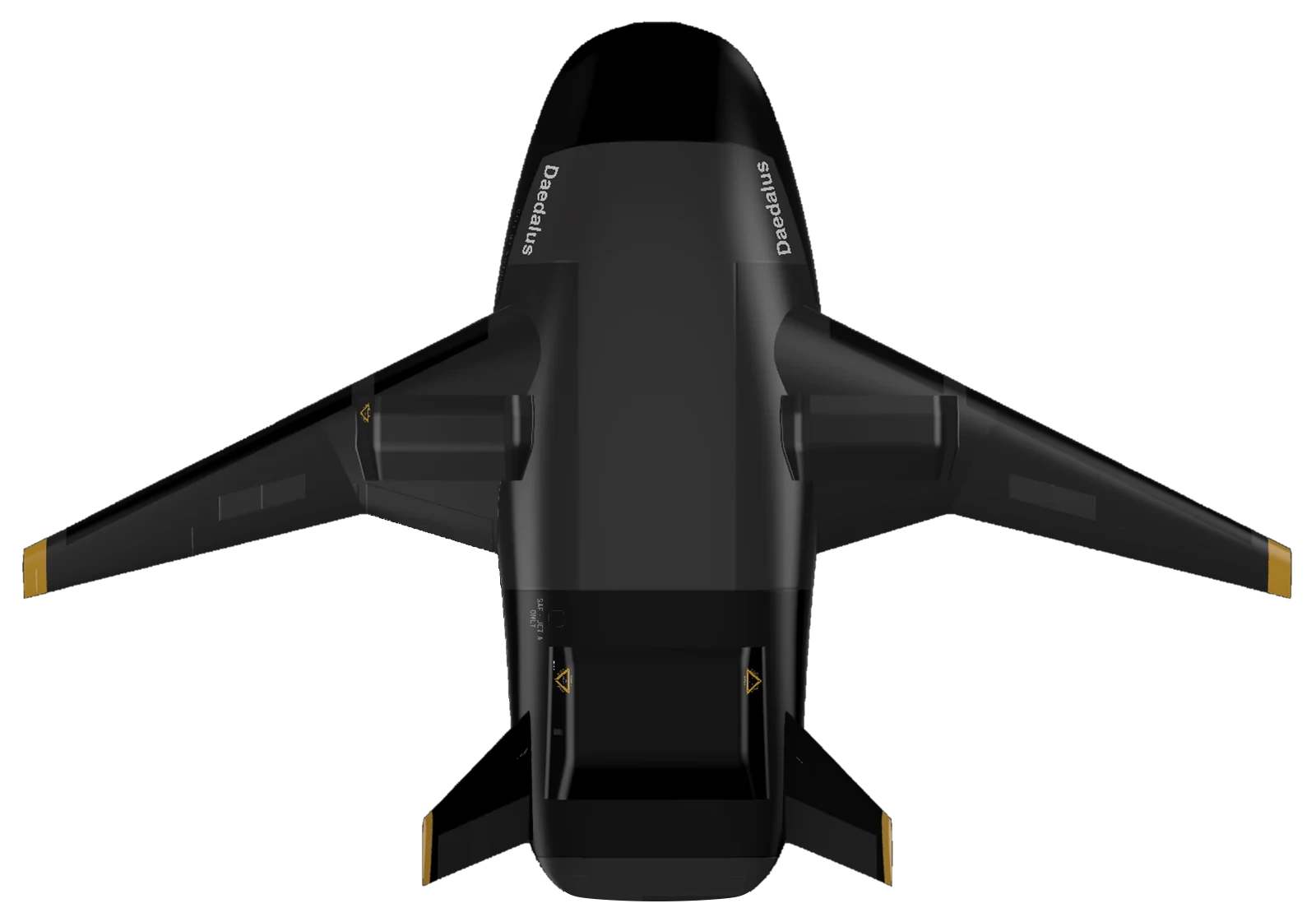
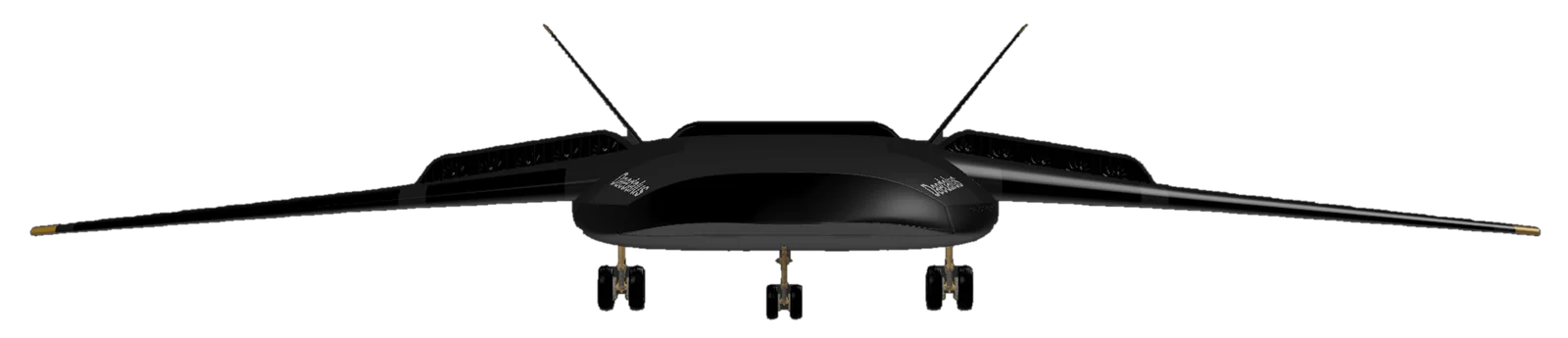
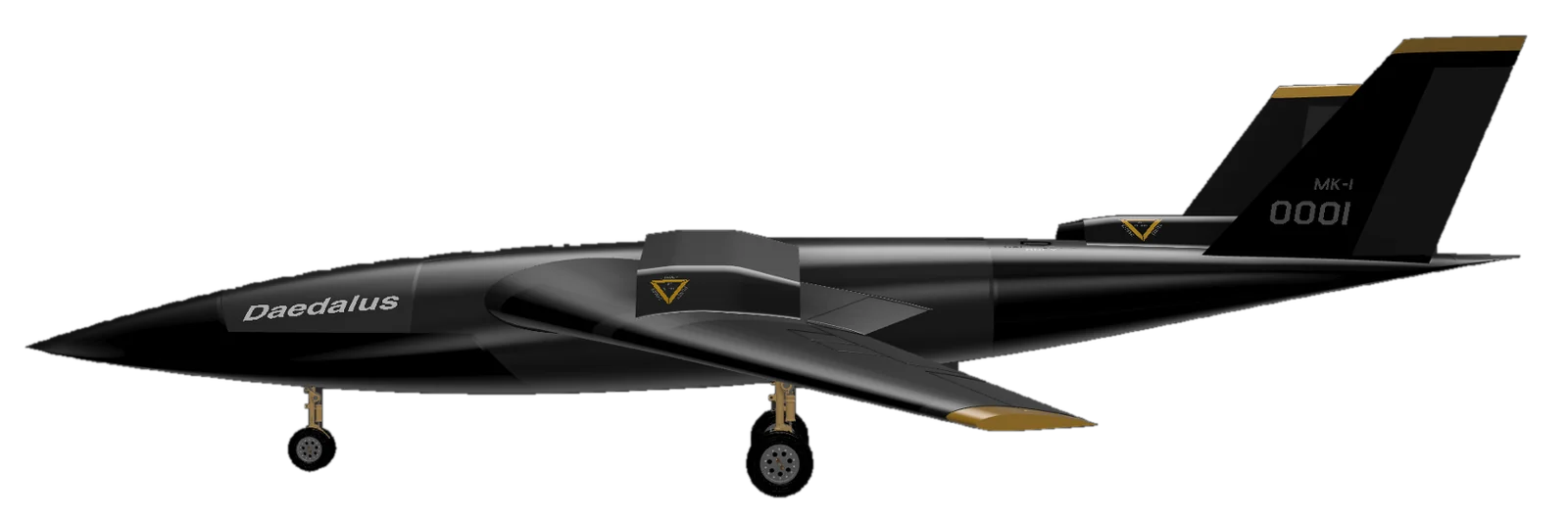
Grid squares are 1 m. Wingspan 10.5 m.
Full-size USTOL autonomous air vehicle
- Wingspan
- 10.5 m
- Max cruise speed
- 402 km/h
- Max payload
- 500 kg
- Max cruise ceiling
- 6,706 m
- Endurance
- 15 hours Half payload, auxiliary tanks
- Range
- 3,620 km
Design targets for the Mk-I. We will replace them with measured figures as flight testing produces them. USTOL means ultra-short takeoff and landing.
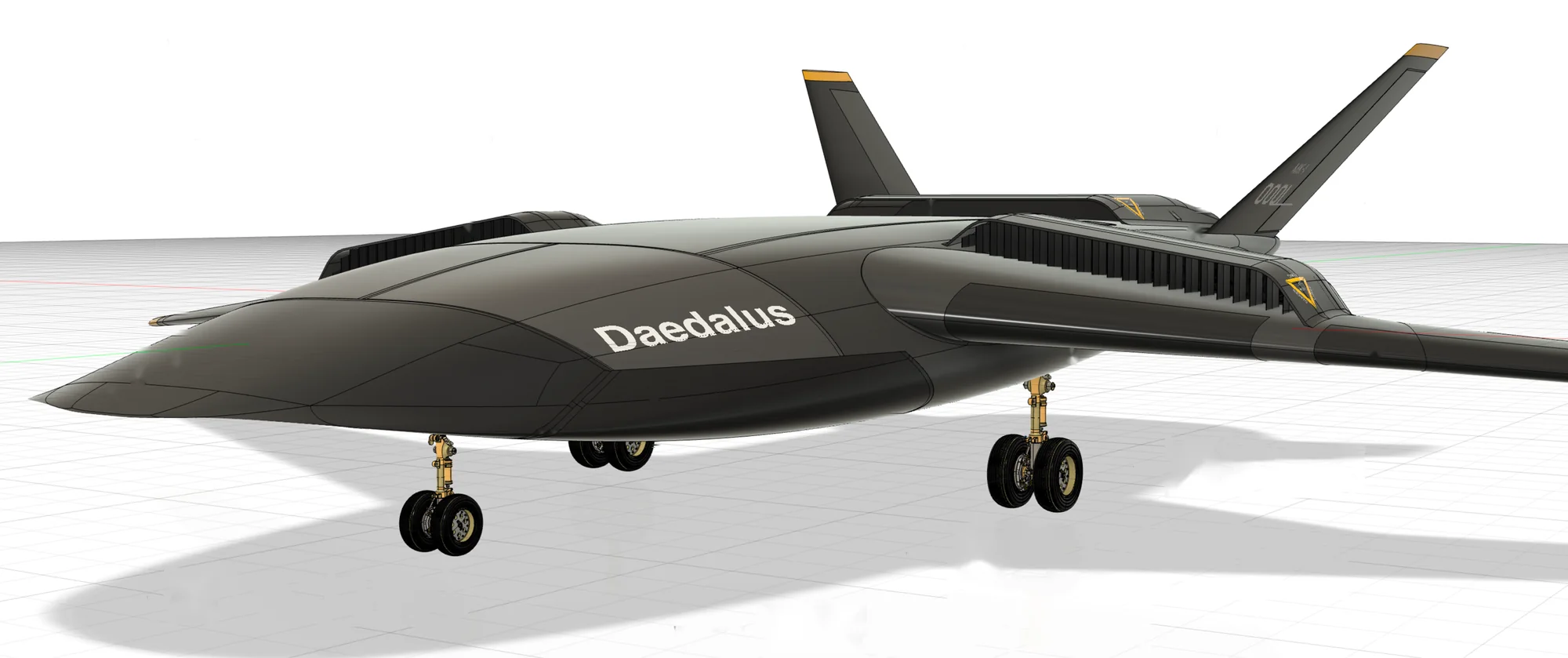
Inside the airframe
Select a point on the aircraft, or pick from the list.
-
AI-assisted mission autonomy with distributed command and control. A single pilot in command coordinates a group of autonomous aircraft.
-
A modular, open design. Sensors, payloads, and software can be updated and upgraded without redesigning the aircraft.
-
The fans sit inside ducts on the upper wing. The aircraft is designed to be hard to hear from the ground.
-
Many electric ducted fans along the wing and aft fuselage, integrated with fly-by-wire flight controls.
-
A large tank for long patrols. Auxiliary tanks extend time on station further.
-
Ice protection for cold, wet conditions at altitude.
-
A hybrid-electric powerplant drives the fans. It is designed to run on sustainable aviation fuel.
-
A multi-mission bay that takes different payloads, from interceptor launch tubes to civil mission equipment.
-
A second bay for a range of smaller autonomous deployable aircraft and payloads.
-
The airframe forms a Faraday cage around the avionics and sensors to protect them from electromagnetic interference.
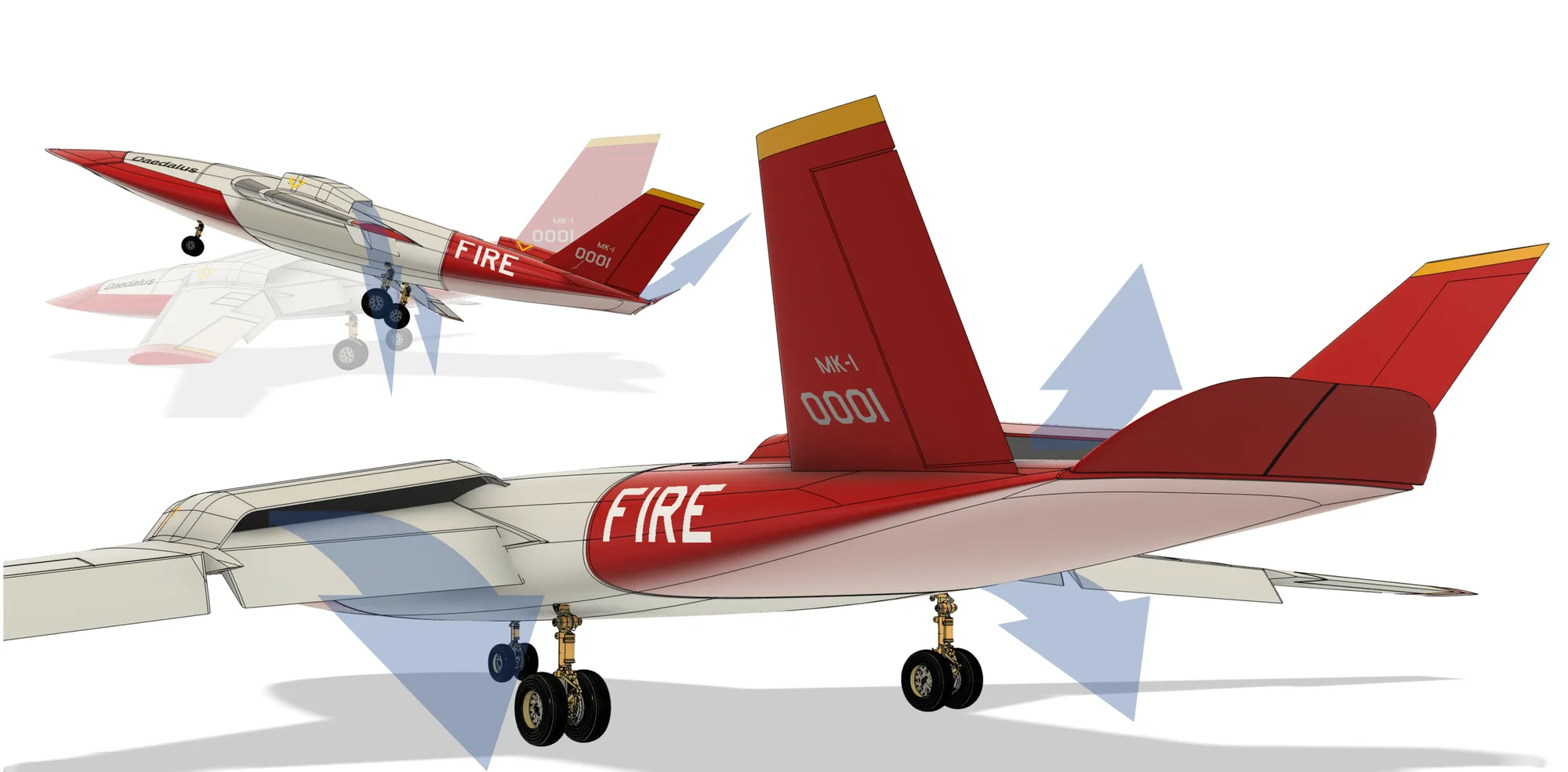
Near-vertical operations without the cost of vertical lift
Vertical-takeoff aircraft pay for hovering with rotors, tilt mechanisms, and weight they carry for the whole flight. Daedalus is a fixed-wing aircraft that gets close to the same result another way. It combines three things.
- Distributed electric ducted fans
- Many small fans along the wing instead of a few large engines.
- Upper-surface-blown flaps
- The fans blow across the top of the wing and its high-lift flaps. The air follows the flaps downward, and the wing keeps producing lift at very low speed.
- A full-authority blown elevator
- Separate fans blow over the elevator, so the aircraft has pitch control even at zero speed over the ground.
The result is an aircraft designed to work from short, unprepared surfaces: a road, a field, a clearing. The lift system is patent pending.
The interceptor
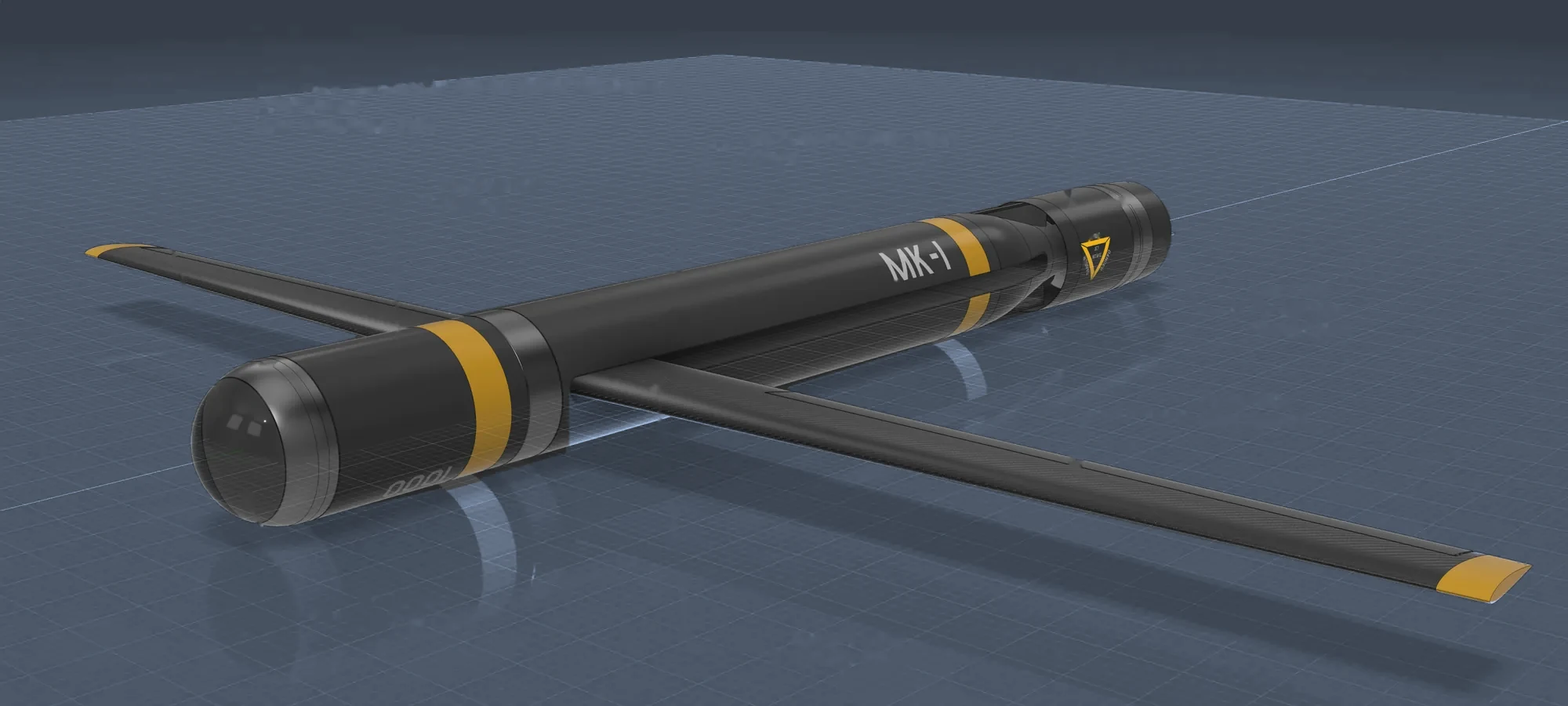
A tube-launched, low-cost drone built to stop other drones. The mothership releases it at altitude. It finds the target with its own sensors and closes on it.
-
Optical and infrared sensors in the nose guide the final approach. Options include an electro-optical camera, mid-wave and short-wave infrared, lidar, and a laser rangefinder.
-
A radio-frequency Doppler fuze senses the target at close range, so the interceptor does not need a direct hit.
-
In the air-defense role this section carries a fragmentation warhead. The airframe is payload-agnostic: the same tube-launched vehicle can carry civil payloads instead.
-
A simple tubular airframe designed for low unit cost and production in large numbers.
-
Spring-loaded wings fold flat against the body inside the launch tube and open on release.
-
An electric ducted fan at the tail. No fuel system, few moving parts.
-
Low-cost fly-by-wire thrust vectoring steers the interceptor in place of a conventional tail.
-
Electrically actuated control surfaces on the wing, commanded by the flight computer.
One airframe, more than one mission
The mothership does not need a runway, and its bays take different payloads. The same aircraft, built on the same line, serves civil protection as well as air defense.
-
Counter-drone defense
Persistent airborne protection for cities, airports, bases, and critical infrastructure.
-
Wildfire response
An unmanned tanker that works from a fire road or a clearing near the fire line, by day or night, with no crew at risk.
-
Search and rescue
Long endurance and sensors over the search area, flown from a short strip nearby instead of a distant airfield.
-
Medical and relief logistics
Supplies delivered where there is no runway, road, or bridge.
-
Cargo and transport
Resupply to dispersed sites that do not have an airfield.
-
Surveillance and reconnaissance
A sensor platform that stays on station for hours and moves to where it is needed.
What the system is designed to do
- Coverage
- Scales from a single mothership to a coordinated fleet. The defended area is sized to the job: a base, an airport, a city.
- Altitude
- Patrol at about 20,000 ft. Interceptors start above the threat and dive.
- Persistence
- Up to 15 hours on station per aircraft, with relief aircraft rotating in.
- Takeoff and landing
- Ultra-short takeoff and landing from unprepared surfaces. No runway, launcher, or recovery equipment.
- Command and control
- Built on an open architecture and designed to MOSA (Modular Open Systems Approach) principles, so it connects to existing command systems and takes new sensors and payloads. One operator supervises many aircraft.
- Cost
- Airframes and interceptors are designed for low unit cost and volume production, so the cost of an engagement stays close to the cost of the threat. The goal is to make mass drone attacks and asymmetric warfare economically and operationally futile.
- Power
- Electric at the small end. Hybrid-electric, ready for sustainable aviation fuel, on the larger aircraft.
Synthetic Skies
Synthetic Skies designs autonomous aircraft for defense and civil protection. Carbon Dome is our first system. The Daedalus airframe and the interceptor are our own designs, and the lift system behind the aircraft's short takeoff is patent pending.
Founder
30 years in flight controls and high-lift systems
Three decades of engineering on commercial airliners, fighter jets, military transports, and helicopters, plus unmanned aircraft taken from a clean sheet to flight test. Carbon Dome’s short-takeoff lift system and blown elevator build directly on that work.
- Partnerships
- We work with integrators, manufacturers, and public agencies. If Carbon Dome or the Daedalus airframe fits a need you have, we would like to hear about it.
- Careers
- We are not hiring through this site yet. If you design, build, or test aircraft and this work interests you, write to us.
Request a briefing
Tell us who you are and what you need to protect or move. We will reply with next steps.
Or write to contact@synthetic-skies.com.